
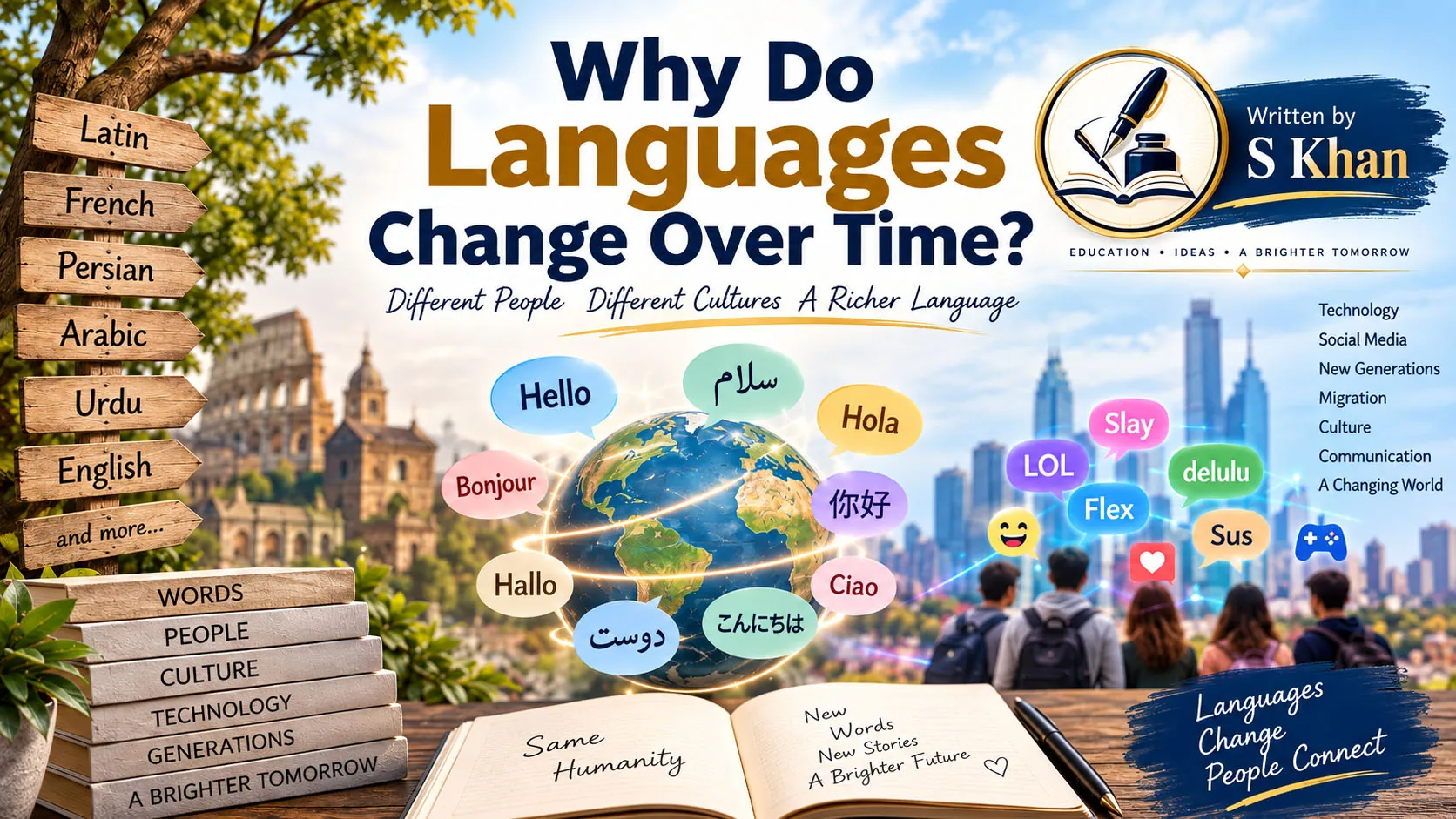
Why Do Languages Change Over Time?
Language change is the continuous process of changes and alterations in words, accents, pronunciation, and grammar in a certain language over time. Languages do not remain the same as they were before. They continue to develop and change according to human nature and the way society grows.
Language change often occurs due to the mixing of different cultures. When people from different cultures meet and communicate, they may use words from other languages and add them to their own language. For example, many words in the English language have been borrowed from French, Latin, Italian, Persian, and other languages, and nowadays they have become a part of the English language.
Language change also occurs because of changes in generations or the generation gap. Today is the era of Gen Z and Gen Alpha. They are creating new words and shortening old or long expressions for convenience, which can lead to changes in language. Examples include LOL, delulu, slay, flex, and sus. Social media and other platforms, such as online gaming, spread these new words, and eventually some of them become a part of everyday language.
Pronunciation and grammar also change over time, as people may stop using older grammatical structures and words to make their language easier and more fluent. Many older words containing a large number of letters or having complex meanings may be replaced by shorter or simpler forms. Some people create short forms because they want to communicate more quickly and easily. After some time, these shorter forms may become widely accepted and contribute to language change.
The meanings of words can also change. Words used in past decades do not always have the same meaning today. Social media can spread new meanings of words so quickly and easily that they may gain attention within just a few days.
Technology also contributes to language change. Words such as internet, Wi-Fi, emoji, and hashtag were not commonly used in everyday language in the past, but nowadays they are very common.
Migration also contributes to language change. When people travel or move from one place to another, they bring their own culture, language, and traditions with them. People who speak different languages interact with one another and may adopt words, pronunciation, accents, and expressions from each other, which can add new words and expressions to their languages.
In my opinion, language change does not make a language weak. Instead, continuous change keeps a language alive and fresh and connects it with both history and the future. Language can be seen as a living system of communication between human beings. Language change is natural and shows how human beings continue to adapt, grow, and communicate over time.