
Shanzay KhalilSep 7, 2026
How Do Australian Schools Differ from Pakistani Schools?
Written by: Shanzay Khalil
Student in NSW School, Australia
Student in NSW School, Australia
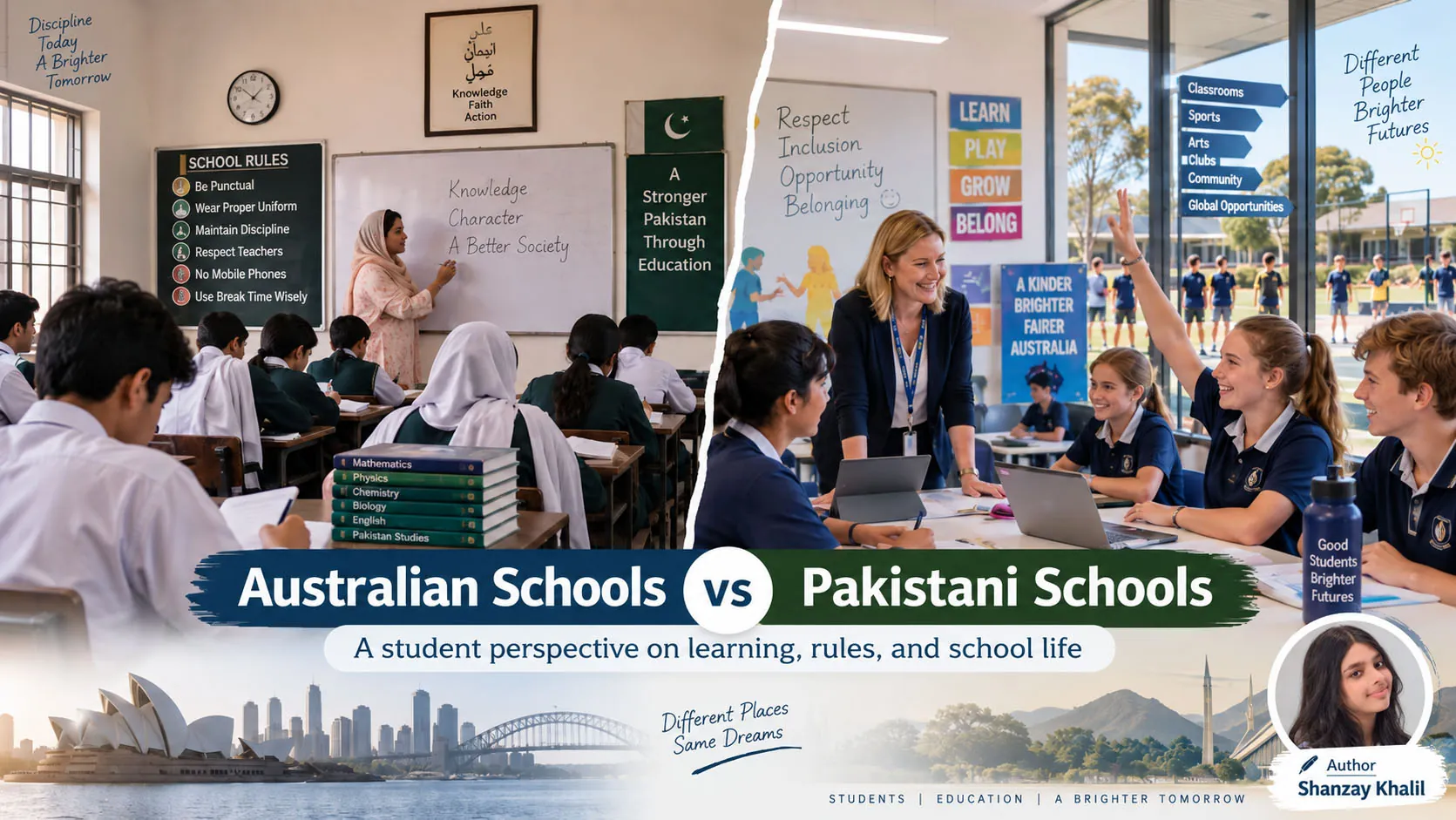
Pakistani schools often focus mostly on studying, with less time for fun, jokes, sports, or events. The rules can be very strict, even about small things like the colour of your hair tie, which can sometimes feel unnecessary. Teachers do not always understand students, and in some cases, students may feel that teachers lower grades if they do not like someone while giving better marks to their favourites. There is also a lot of homework, and instead of giving clear punishments like detention, teachers may simply scold students, which does not always work.
Lunch breaks are often short, sometimes only about 20 to 30 minutes, which may not feel like enough time to eat, use the bathroom, and relax. If a student answers a question or talks in class, some teachers may think they are being rude or talking back, even if the student is just trying to participate. Teachers may expect students to listen quietly without asking many questions, but if students stay completely silent, they can also be seen as uninterested or disrespectful. This can make it hard for students to feel respected or confident.
On the positive side, it can be easy to make friends in Pakistani schools, and students who work hard academically can do very well. However, strict rules and experiences of unfair treatment can sometimes make school stressful.
In Australian schools, things can be quite different. Teachers generally try to treat students fairly and avoid favouritism. There are many activities, such as sports and school events, so school can feel more fun and balanced. In my school experience, there are separate breaks, including about 20 minutes for recess and 40 minutes for lunch, giving students more time to eat and relax.
Discipline is usually handled with clear rules and consequences, such as detention, which helps students understand what is expected of them. Teachers encourage students to ask questions and take part in class, which can help with learning. Students also change classes and meet different people, which helps them grow, become more independent, and make new friends.
However, there are still some problems. Bathrooms in schools in both countries can sometimes be dirty, and bathroom passes in Australian schools can be limited, which can be frustrating. Sometimes, students may also feel that teachers do not notice how hard they work and instead praise students who appear to do less, which can feel unfair.
Overall, from my experience, Australian schools offer a more supportive and enjoyable environment where students can learn and grow, while Pakistani schools tend to focus more strongly on strict rules and studying, sometimes at the cost of students’ confidence and happiness.